

A UAE Holding Company for a Canadian Startup in 2026: ADGM SPV or DIFC Prescribed Company
Founders and startups · Corporate matters · 21 minutes
A UAE Holding Company for a Canadian Startup in 2026: ADGM SPV or DIFC Prescribed Company
In short. A Canadian founder can now form a holding company in either of the UAE’s two common-law financial centres, an ADGM special purpose vehicle or a DIFC Prescribed Company, without a Gulf shareholder, a Gulf asset or a UAE subsidiary already in place. Since 24 July 2026 the DIFC’s Prescribed Company has been open to any applicant with a licensed corporate services provider behind it, and ADGM has unofficially announced that its special purpose vehicle no longer needs a connection to the UAE or the Gulf, with the official announcement expected soon. Both vehicles are passive by the terms of their licence: they hold shares and assets, and the company that trades and employs sits beneath them on an operating licence. For a founder in Toronto that opens a parent in a common-law financial centre, in the form the Gulf’s funds and family offices already invest in, under a tax regime with no personal income tax and a nil rate for qualifying free-zone income. Which centre is then decided by the investor whose documents will govern the next round, by the option plan, and by the bank that has to open the account; a Canadian shareholder adds reporting and a residence test on the Canadian side. The decision is made before the first form is filed and recorded in both places.
This article describes the law, the registries’ published requirements and the market’s published forms in general terms and as they stood on 8 October 2026. The linked primary sources support it; the position of a particular company, and the tax on both sides, require advice before anything is filed. Fauri Law advises founders, investors and their advisers on Ontario, federal and UAE corporate law from its offices in Toronto and Abu Dhabi.
The two centres and the two vehicles, briefly
The UAE is a federation of seven emirates with a civil-law system whose courts sit in Arabic. A federal law of 2004 allows the federation to designate financial free zones that are exempt from federal civil and commercial law, while federal criminal law continues to apply, and each zone writes its own company, contract, employment, insolvency and data-protection laws and runs its own registrar, financial regulator and courts. There are two. The Dubai International Financial Centre, the DIFC, was established in 2004 in the centre of Dubai; Abu Dhabi Global Market, ADGM, was established by federal decree in 2013 and opened in 2015 on Al Maryah Island in Abu Dhabi. ADGM’s Application of English Law Regulations 2015 make English common law, including equity, directly applicable there; the DIFC writes its own statutes on common-law models and fills the gaps with the law of England and Wales. The ADGM Courts and the DIFC Courts are common-law courts with a Court of First Instance and a Court of Appeal, sitting in English, whose judgments are enforced through the onshore courts of their emirate. For an Ontario founder the practical meaning is that the articles, the shareholders’ agreement and the share classes read as a Canadian lawyer expects them to. The UAE levies no income tax on individuals; its corporate tax, on the Ministry of Finance’s published position, is nil on taxable income up to AED 375,000 and nine per cent above it, and a qualifying free zone person pays nil on its qualifying income, which includes the holding of shares and other securities, on conditions set out below.
The two vehicles are the passive holding companies each centre offers. An ADGM special purpose vehicle, the SPV, is an ordinary ADGM private company limited by shares whose licence is for that single activity; ADGM describes it as a passive holding company that cannot conduct operational business or hire staff, and a licensed company service provider submits its application and provides its registered office. A DIFC Prescribed Company, the PC, is a DIFC private company formed under the Prescribed Company Regulations, licensed for the activity of a holding company, forbidden a workforce, and administered by a DIFC-licensed corporate services provider unless its controller is a regulated, listed, government or DIFC-registered entity. Neither can run a business. The operating company is a different licence, a technology or innovation licence in either centre or a mainland licence from the emirate’s economic department, under which a company trades, employs and sponsors visas. “Passive” and “operating” are used in that sense throughout. Both centres also offer a foundation, a separate legal person without shareholders formed under ADGM’s Foundations Regulations 2017 or the DIFC Foundations Law of 2018, run by a council and overseen by a guardian, which founders and families place above a holding company for succession and estate planning; under the corporate tax law a family foundation may apply to be treated as transparent, so that the tax falls on the beneficiaries rather than the foundation, and for a Canadian-resident founder the Income Tax Act’s rules on non-resident trusts are the first question before one is used. The Delaware corporation, the third form founders compare, is the subject of a separate piece.
What the 2026 changes make possible
The DIFC’s Prescribed Company Regulations 2026 came into force on 24 July 2026, amending and restating the 2024 Regulations. Until then an applicant had to fit one of four routes: control by a person from the Gulf or by a DIFC-registered or DFSA-authorized entity; registered assets in the Gulf; one of a short list of qualifying purposes; or a director who was an employee of a corporate services provider. The 2026 Regulations replace the four routes with a single administrative condition: unless the company is an Exempt PC, it appoints a DIFC-licensed corporate services provider, which handles its filings and answers to the Registrar for it. A non-exempt company formed before 24 July 2026 has six months from that date, or the longer period the Registrar allows, to appoint one, which on the Companies Law’s thirty-day month runs to 20 January 2027; the fine for failing is up to US$20,000, and the Registrar may revoke the company’s status. What did not change is what the company is: its licence is restricted to the activity of a holding company, it may not establish a DIFC fund without DFSA authorization, and it may not maintain a workforce through employees or any other arrangement. For a Canadian founder the meaning is simple: a Dubai holding company that a year ago needed a Gulf controller, a Gulf asset or a provider’s employee on the board now needs a licensed provider and nothing else.
ADGM’s special purpose vehicle has followed. Until this autumn the Registration Authority’s guidance of March 2020 asked an applicant to show “an appropriate connection or ‘nexus’ to the ADGM, the UAE and/or to the GCC Region”, through ownership or control by a person based in the region, assets in the region, transactions of benefit to the UAE or securities on an ADGM exchange, and gave a vehicle wholly owned by a non-resident holding only assets outside the region as the example of what would not be accepted. ADGM has now unofficially announced that the requirement no longer applies, and the firm has been informed through its sources that the official announcement is expected soon. In its place an applicant gives three confirmations: the purpose of the vehicle, the location of its assets or equity, and compliance with the Companies Regulations. Two conditions remain. The vehicle stays passive, and every ADGM licence holder must maintain at least one authorized signatory holding a UAE residence visa under the licence conditions, with ADGM’s incorporation checklist admitting a UAE or GCC national in the alternative; neither requires the shareholders or directors to live in the UAE. Until the official announcement is published, the ADGM-licensed service provider that will submit the application confirms the filing list on the day. The rest of the regime is settled: a licensed company service provider has been mandatory for a non-exempt vehicle since 12 July 2021, and the April and June 2026 amendments to the Companies Regulations prohibited bearer shares and opened the directors of a Restricted Scope Company to public inspection. For a founder in Toronto with no Gulf shareholder and no UAE asset, both financial free zones are now open as the home of the holding company, where a year ago only the DIFC was, and only through a provider’s employee on the board.
The third change is on the mainland. Federal Decree-Law No. 20 of 2025, in force since 15 October 2025, amended the Commercial Companies Law so that a limited liability company may have classes of shares with different voting, profit and liquidation rights, and recognized drag-along and tag-along rights in the constitution. The categories of shares await a Cabinet decision, and none had been published in the sources checked as at 8 October 2026. Until it is, an investor that expects preference shares in the form it knows is usually put into a company whose law already carries them, which is one of the reasons the holding company sits in a financial free zone while the operating company sits where the work is licensed.
Why a UAE holding company, for a Canadian founder
The firm has seen Canadian founders choose the structure for four reasons, none of them the licence fee.
Capital. The Gulf’s venture funds, accelerators and family offices invest in ADGM and DIFC companies as a matter of course, and a UAE parent puts the cap table in the form their documents are written for. Hub71 in Abu Dhabi asks a selected startup to run its ADGM operating company under a holding company, with incentives that run to subsidized housing, office space and health insurance for up to 25 employees for up to three years.
Market. The operating company, on the mainland or in a zone, gives the business the UAE and, through it, the Gulf: full foreign ownership for most activities, a currency pegged to the US dollar, and a buyer that is often the government itself. In the firm’s experience the two centres open different doors. Abu Dhabi is the capital, where the federal ministries, the regulators and the sovereign and government-related buyers sit, and where the contracts in infrastructure, data centres, defence and aerospace, artificial intelligence and financial technology are let; Dubai is where real estate, leisure, the family offices, venture capital, investment banking and consulting are concentrated. Both are a base for the wider Gulf, Saudi Arabia included, though each Gulf state licenses and procures on its own terms. The buyer in every case contracts with the licensed operating company; the holding company’s centre decides where the group sits, not what it may sell. The investment agreement between Canada and the UAE has been in force since 19 May 2026, and the trade agreement concluded in July 2026 takes effect once signed and ratified; the licensing choices on the operating side are the subject of Setting Up in the UAE from Canada.
Tax. Dividends received from a UAE company are exempt from UAE corporate tax, the withholding tax rate is nil, and a qualifying free zone person pays nil on its qualifying income, provided the conditions are met, among them adequate substance in the zone and audited financial statements, which the Registration Authority’s guidance explains an ADGM company must keep whatever its size. On the Canadian side, the tax convention between Canada and the UAE, in force since 2004, is what allows the active business earnings of a UAE subsidiary that is resident there under the convention to be paid to a Canadian corporate parent as dividends out of exempt surplus, while passive income is taxed in Canada as it is earned under the foreign affiliate rules. Two cautions sit beside the benefits: a company incorporated in ADGM or the DIFC and managed from Toronto is resident in Canada under the central management and control test, and loses the UAE position with it; and incorporation in a financial free zone does not of itself make a company a qualifying free zone person. The accountants on both sides apply these rules to the actual group before the structure is fixed.
Cost. The registries’ published fees are modest and are in the table below; the real budget is the provider, the audit where one is required, and the bank’s onboarding.
Passive or operating: the distinction that organizes the structure
How many companies a business in the UAE needs follows from the parent it chooses, and the 2026 changes did not alter that; they widened who may use each parent. The operating company holds the licence for the activity, employs the team, signs the customer contracts and sponsors the visas, and it sits where the work is done and licensed: a mainland licence, the ADGM Tech Startup licence for a company in the Hub71 programme, the DIFC Innovation licence for one in the DIFC’s. Hub71’s own guidance describes the structure in a sentence: a selected startup sets up a Tech Startup licence operating company in ADGM “and make it a subsidiary of their holding company”, and the holding company may be incorporated in any jurisdiction, Canada included. The holding company is where the cap table lives: it holds the shares of the operating company, it is the party to the shareholders’ agreement, its constitution carries the preference terms, and in most venture structures it grants the options.
Whether the two must be separate companies turns on the parent. The restriction is a licensing rule rather than a feature of the corporate form. ADGM’s licence conditions require every licence holder to carry out only the activity to which its licence relates, and an SPV’s licence is for that activity alone; a Prescribed Company’s licence is restricted by regulation 3.5.2 to the activity of a holding company, and regulation 4.3 forbids a workforce. A founder who chooses either has chosen two companies, because the parent cannot do the work. The two vehicles differ in one respect: an ADGM SPV can later apply to vary its licence to an operating activity, for the fee in the Registration Authority’s schedule, after which it is an ordinary licensed company and no longer an SPV; the Prescribed Company Regulations provide no route to convert other than the Registrar’s revocation of the status. An ADGM or DIFC company on an operating licence can trade and, subject to its licence, hold subsidiaries and carry share classes, so a group built on one can run as a single company until an investor asks for the cap table to be separated from the operating liabilities, which most do at the first priced round.
Six ways to structure it, at a glance
The passive-or-operating rule, the tax convention’s residence article and the investor’s documents between them produce six structures that the firm sees Canadian founders consider; a companion piece sets each one out with its own chart and its costs on the Canadian side. In outline, they are a single passive subsidiary of the Canadian company, holding intellectual property, investments or the shares of a future operating company, with the option to form an operating company beneath it later; layered holdings in ADGM and the DIFC with operating companies beneath them, for a group that wants one vehicle per business line or per investor group; a Canadian parent that owns operating companies in both centres directly, which needs no passive vehicle at all and keeps its Canadian status; the flip, in which the founders exchange their shares in the Canadian corporation for shares of a UAE parent that then owns the Canadian company and forms UAE subsidiaries, the structure the Gulf’s investors are used to and the one with the largest Canadian tax consequences; stand-alone sister companies, with no ownership between the Canadian business and the UAE business; and a joint-venture vehicle with a Gulf partner, holding the licensed company that does the joint business. The first and the third are where most Canadian businesses start; the fourth is where many end up when the region’s investors lead a round, and it is planned with the accountants on both sides before it is signed, because the share exchange is a disposition without the Income Tax Act’s rollover and the Canadian company ceases to be a Canadian-controlled private corporation the day a non-resident parent controls it.
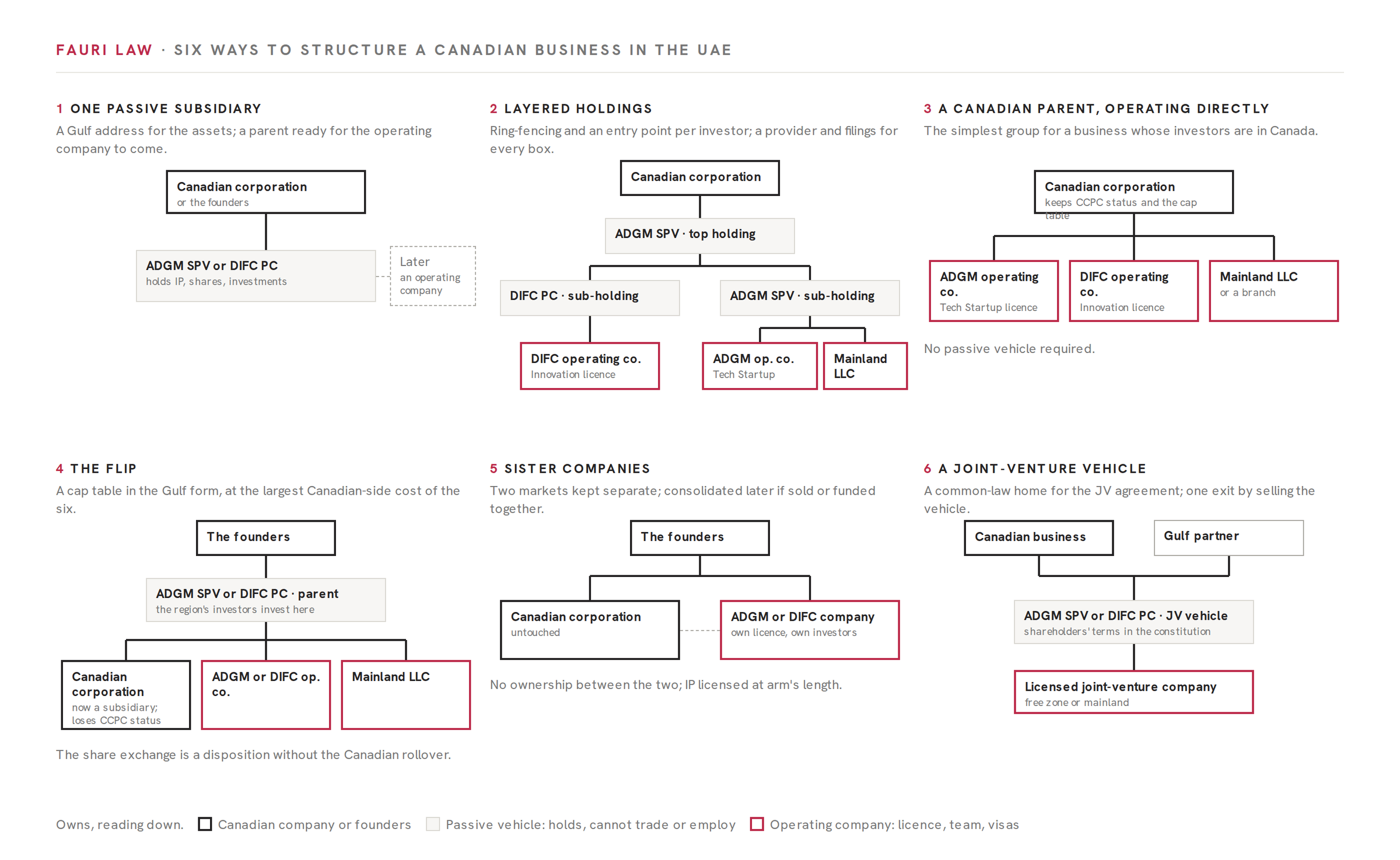 The six structures at a glance. Each is set out, with its own chart and its Canadian-side costs, in the companion piece.
ADGM or the DIFC
The choice between the two centres is made on what surrounds the company rather than on corporate mechanics, because both vehicles carry preference shares, conversion, an option pool and a shareholders’ agreement in the form investors know. The table sets the two forms out line by line; the verdict on each comes first.
ADGM. The special purpose vehicle is the right parent for a business whose operating company, founders or investors are in Abu Dhabi: a Hub71 company, a business whose first cheque is from an Abu Dhabi fund or family office, or a business selling to the capital’s government, regulators and government-related buyers in infrastructure, data centres, defence and aerospace, artificial intelligence and financial technology. English common law applies directly, and the SPV is the only one of the two vehicles that can later vary its licence and become an operating company without forming another one. Its conditions are the signatory holding a UAE residence visa, the company service provider, a public register of directors, and, until the official announcement is published, the service provider’s confirmation of the filing list for an applicant with no Gulf connection.
The DIFC. The Prescribed Company is the right parent for a business whose customers, founders or investors are in Dubai, where real estate, leisure, the family offices, venture capital, investment banking and consulting are concentrated, for a family office or an angel syndicate forming a vehicle, and, since 24 July 2026, for any founder who wants a UAE holding company on Regulations as enacted, with nothing to confirm but the appointment of a corporate services provider. Its registry fees are the lower of the two, and the DIFC Innovation licence gives the operating company a home in the same centre. Its conditions are the provider and a licence restricted to holding-company activity, with no route to an operating licence other than forming another company.
| ADGM special purpose vehicle | DIFC Prescribed Company | |
|---|---|---|
| What it is | A private company limited by shares (or a Restricted Scope Company) licensed in ADGM for the activity of special purpose vehicle, under ADGM’s Companies Regulations 2020 and its licensing rules. | A private company limited by shares under the DIFC Companies Law, formed under the Prescribed Company Regulations 2026 and licensed for the activity of a holding company. |
| Who may form it | Any applicant, on ADGM’s unofficial announcement that the connection to ADGM, the UAE or the Gulf its guidance asked for until 2026 is no longer required; the official announcement is expected, and the service provider confirms the filing list on the day. At least one individual authorized signatory must hold a UAE residence visa under the licence conditions; the checklist admits a UAE or GCC national in the alternative. | Any applicant, since 24 July 2026. The qualifying requirements of the 2024 Regulations are no longer conditions of incorporation. |
| Who runs the file | An ADGM-licensed company service provider, which submits the application for a non-exempt vehicle and provides the registered office. | A DIFC-licensed corporate services provider for a company that is not an Exempt PC; the registered office is in the DIFC. |
| What it may do | Hold shares, intellectual property and other assets and enter into the transactions that holding them requires. No operational business, no staff, no office beyond the provider’s address. The licence can be varied to an operating activity on application and a published fee, after which the company is no longer an SPV. | The activity of a holding company, which its licence is restricted to; no workforce through employees or any other arrangement. A DIFC fund only with DFSA authorization. No route to an operating licence other than the Registrar’s revocation of PC status. |
| Shares and options | Classes of shares, preference terms, conversion and an option plan are drafted into the articles under a common-law companies regime; model articles exist for the plain case. Bearer shares are prohibited. | The same, under the DIFC Companies Law. |
| Which law and courts | ADGM’s own regulations, with the common law of England applied as ADGM law, and the ADGM Courts. | DIFC statutes, supplemented by the common law and equity, and the DIFC Courts. |
| What is public | Directors, nominee status and shareholders on the public register, and since June 2026 the directors of a Restricted Scope Company unless the Registrar exempts it; beneficial owners reported to the Registrar and not published. Annual accounts filed, with an audit exemption for small companies. | The company’s registered particulars on the DIFC public register; beneficial owners reported to the Registrar and not published. Accounts as the Companies Law requires, with its audit exemptions. |
| Fees published for setting up | US$1,900 to set up and US$1,400 a year to renew, including the data-protection fee, with a US$100 annual confirmation statement, on the Registration Authority’s schedule of fees (January 2025) as read on 6 October 2026; a Restricted Scope Company pays US$3,100 more. The provider’s fee is on top. | US$100 to apply, US$1,000 for the grant or renewal of the licence and US$300 for the annual confirmation statement, under Appendix 1 of the Regulations, plus the AED 20 Knowledge and Innovation Dirham on the DIFC’s SPV page and the data-protection fee where personal data is processed. The provider’s fee is on top. |
The “who may form it” line is where the two forms differed until this summer, and it is the line to re-read on the day: a founder with no Gulf shareholder, no Gulf asset and no UAE subsidiary can form a Prescribed Company on the Regulations as enacted, and can form an ADGM vehicle on the policy ADGM has unofficially announced, with the official announcement expected, once the service provider has confirmed the filing list and a qualifying signatory is in place.
The three questions that decide it
The investor’s documents. Whether a fund can invest in a company in a given jurisdiction is a question of the fund’s own documents: its agreement with its limited partners, its investment policy, and the practice of its counsel. None of these is public and none is the same from one fund to the next, so there is no rule to state; there is only the question to ask. In the firm’s experience, and on the market’s published forms, funds, accelerators and family offices based in the Gulf commonly invest in ADGM and DIFC companies, while funds raised in the United States commonly invest in Delaware corporations and ask a company formed elsewhere to reorganize under a Delaware parent before the round closes, a comparison that belongs to its own piece. So the first question to a lead investor, before valuation, is which company its documents are written for; the holding company is then formed to fit the answer.
The operating company and the option plan. In most venture structures the holding company grants the options, because it is the company whose shares the investors hold and whose constitution carries the vesting and buy-back terms. Nothing in the law requires the pool to sit there; what decides it is which company’s shares can be issued in classes, held on vesting terms and bought back on departure without a filing each time. A mainland limited liability company is not yet that company: the Cabinet rules that give its share classes their categories are awaited, and a transfer of an LLC share still runs through an amendment of the memorandum before the licensing authority. So the plan is usually adopted by the holding company, under ADGM or DIFC law, and the operating company’s employees are granted options over their employer’s parent.
The bank. A company with no staff, no premises, no revenue and a passive activity is the account a bank opens most slowly, and no ownership or residence profile guarantees an account. The bank’s questions are the same in either zone: the ownership chain up to the individuals, the source of the funds, the business of the companies below, the licence and the constitution, and the residence of the signatories. In the firm’s experience the file that moves is the one in which the ownership is clear on paper, the operating subsidiary is licensed and a signatory is resident in the UAE; a holding company formed ahead of those waits.
The Canadian shareholder
A Canadian founder, or a Canadian corporation, on the cap table of a UAE holding company adds a set of questions on the Canadian side, and none of them is answered by the UAE registry. What follows names them; the analysis belongs to the group’s accountants.
The first is who the shareholder is. A Canadian corporation holding the shares keeps the UAE company inside a Canadian group; a Canadian individual holding them personally does not. Each carries its own reporting in Canada, an annual information return where the UAE company is a foreign affiliate under the Income Tax Act and the foreign-property return above a cost threshold where it is not. The convention’s residence article sets the limit of what the structure can do: a UAE company is a resident there for the convention only if all of its shares are beneficially owned by UAE residents, which for individuals the convention confines to UAE nationals, or if all or substantially all of its income comes from the active conduct of a trade or business in the UAE other than an investment business. An operating subsidiary can meet the second limb; a passive holding vehicle owned by Canadians, wherever they live, usually meets neither, which is why the convention’s benefits attach to the operating company rather than to the vehicle above it.
The second arises where the operating company is Canadian. A Canadian-controlled private corporation is a private Canadian corporation other than one controlled, directly or indirectly in any manner whatever, by one or more non-residents or public corporations, so a parent that is not resident in Canada ends the status; and whether the parent is resident in Canada is a separate question from where it was incorporated, because a corporation incorporated abroad can be resident in Canada under the common-law test of where its central management and control is exercised. The Canadian company’s directors also stay under their own statute: a federal corporation must have at least a quarter of its directors resident Canadians, or at least one where it has fewer than four, while an Ontario corporation has had no residency requirement since 5 July 2021.
The third is documents. The resolutions and powers of attorney a Canadian corporation signs for a UAE registry cross the border under the rules in Setting Up in the UAE from Canada, and are passed and legalized before the registry’s timetable starts.
The sequence, and what goes wrong
The sequence is the same shape in both centres, and the file is prepared once. The investor is asked first, in writing, which company its documents are written for; the operating company’s licence is settled or, where it exists, its share register and constitution are checked for the transfer to the new parent. Then the holding company is formed through the service provider, with the name reserved, the signatory named, the directors, shareholders and beneficial owners identified, the source of funds documented and the articles filed with the application; in ADGM the three confirmations are given, and in the DIFC data-protection registration follows where the company will process personal data. In both, the licence is followed by the register of beneficial owners, corporate tax registration and the bank. The documents the founders hold at the end are the same in both: the constitution with its share classes, the registers, the founders’ shareholders’ agreement with vesting and departure terms, the option plan, the intercompany agreements, and the assignment of intellectual property to the company that is meant to own it; an investor’s counsel will ask for every one of them in due diligence.
The same four errors account for most of the corrective work the firm sees. The holding company is formed before the lead investor is asked, and the round closes only after a reorganization the founders did not budget for. The operating licence is put in the holding company, or the holding company is formed as an operating company, so that a vehicle that may not employ anyone is asked to. Options are promised to early employees over the shares of a company that cannot deliver them on the terms promised, and the promise has to be rewritten into the parent’s plan. And a filing is prepared on last year’s eligibility guidance: a Prescribed Company formed before 24 July 2026 is left without a corporate services provider past 20 January 2027, or an ADGM application is prepared, or abandoned, on an assumption about the connection requirement that nobody checked with the service provider that will file. Each is avoided by settling the investor, the operating company and the bank before the first form is filed.
Questions founders ask
Can a founder with no connection to the Gulf form an ADGM special purpose vehicle?
Yes. ADGM has unofficially announced that the connection its guidance asked for until 2026 no longer applies, with the official announcement expected soon; an applicant gives three confirmations instead, on the vehicle’s purpose, the location of its assets or equity and compliance with the Companies Regulations, and the service provider confirms the filing list on the day. The vehicle stays passive, and at least one authorized signatory must hold a UAE residence visa. A DIFC Prescribed Company has had no connection condition since 24 July 2026.
Does a Canadian company need a passive holding vehicle before it can operate in ADGM or the DIFC?
No. A Canadian corporation can own an ADGM or DIFC operating company directly, or open a branch, and many do. The passive vehicle is chosen when the cap table, the intellectual property or the region’s investors should sit in a UAE parent; a Canadian parent that keeps its cap table in Toronto has no need of one, and keeps its status as a Canadian-controlled private corporation by doing so.
Is a UAE holding company a tax-free structure for a Canadian founder?
No structure is, and the question is better put as what each side taxes. The UAE levies no income tax on individuals and a corporate tax that is nil up to a threshold and nine per cent above it, with a nil rate for a qualifying free zone person’s qualifying income on conditions that include substance and audited accounts. Canada taxes its residents on their worldwide income, applies the foreign affiliate rules to a Canadian shareholder’s UAE company, and treats a company managed from Canada as resident in Canada whatever its place of incorporation; the convention’s benefits reach a UAE subsidiary that carries on an active business there, and usually not a passive vehicle owned by Canadians.
A Prescribed Company formed before July 2026: does anything change?
Yes, unless it is an Exempt PC. A Prescribed Company formed before 24 July 2026 whose controller is not a Registered Person, an Authorised Firm, a Government Entity or a Publicly Listed Entity must appoint a DIFC-licensed corporate services provider by 20 January 2027, or within the longer period the Registrar allows on application; the fine for failing is up to US$20,000, and the Registrar may revoke the company’s status. The routes on which the company was originally admitted are no longer conditions, so a company that has outgrown one of them need not restructure.
For founders and startups: Founders and startups. For Canadian and UAE owners: Canada–UAE corporate matters.
Fauri Law advises founders, investors and their advisers on Ontario, federal and UAE corporate law from its offices in Toronto and Abu Dhabi. Engagement begins with a consultation: Book a consultation or Send a message.
Published 20 October 2026 · Khaled El Fauri