

Setting Up in the UAE from Canada: Free Zone or Mainland
Canada–UAE corridor · Corporate matters · 17 minutes
Setting Up in the UAE from Canada: Free Zone, Mainland, Branch or Subsidiary
In short. A Canadian company setting up in the UAE makes two decisions that usually arrive as one. The first is where the business will sit: a free zone or the mainland, which decides who licenses it, what it may do and where, who may own it and which law and courts govern it. The second is what the Canadian corporation will be in it: the party itself, through a branch, or the owner of a separate UAE company, which decides who the contracting party is, whose balance sheet stands behind the UAE business, what the Canadian board signs and what the Canadian side reports. The two are connected and are settled together. Foreign ownership is no longer the constraint it was, an apostille alone does not get a Canadian document accepted in the UAE, and the investment agreement between the two countries has been in force since 19 May 2026, while the trade agreement, whose negotiations concluded in July 2026, takes effect only once both governments have signed and ratified it.
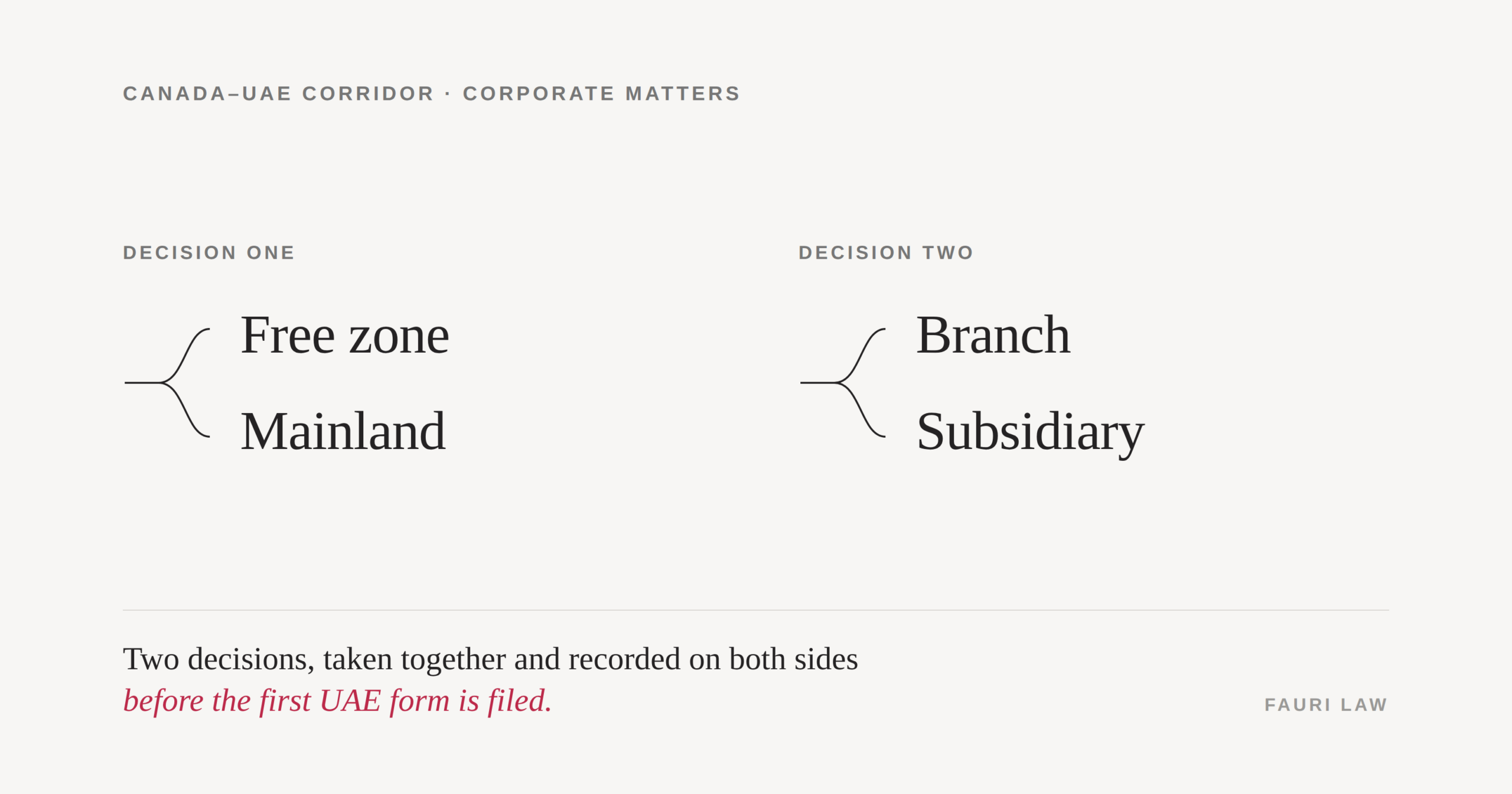
Two decisions, not one
Both decisions are made under UAE law as much as Canadian, because a branch of a foreign company is itself a UAE legal form and each licensing authority decides which forms it licenses for which activities, and both are recorded on the Canadian side. They are connected and are settled together rather than in sequence. The pairing decides most of what follows, from who signs the lease to what the Canadian accountants have to report.
What follows describes the corporate framework in general terms and as it stood on 15 September 2026. Three things are kept apart in it: what the legislation requires, what the authority’s published checklist asks for, and what the published practice is. Checklists change more often than statutes, so each authority’s list is confirmed on the day. Fauri Law advises on the Canadian and UAE sides of the matter from its offices in Toronto and Abu Dhabi.
Decision one: free zone or mainland
| Free zone | Mainland | |
|---|---|---|
| Who licenses it | The free-zone authority, and the zones are not alike. The two financial free zones have their own registries: the ADGM Registration Authority and the DIFC Registrar of Companies. The trading, industrial and services zones register under their own rules: JAFZA and DMCC in Dubai, KEZAD in Abu Dhabi, RAKEZ in Ras Al Khaimah, Hamriyah and SAIF in Sharjah, and the zones of Ajman, Fujairah and Umm Al Quwain. | The economic department of the emirate (Abu Dhabi’s Department of Economic Development; Dubai’s Department of Economy and Tourism). A branch of a foreign company also registers with the federal Ministry of Economy and Tourism. |
| Where it may do business | Inside the zone and abroad as of right. For the mainland it needs a licence or permit for the activity from the emirate, though not always premises there. Dubai’s 2025 resolution gives its free-zone companies three routes into the emirate, a branch licence, a licence for a branch that stays in the zone, or a temporary permit of up to six months, for activities on the Department’s list and with separate records for the mainland business (financial entities in the DIFC excepted). Abu Dhabi’s dual licence lets an ADGM company hold a mainland trade licence and serve clients in the emirate without an office there. What the line means in practice is set out below. | On the mainland, for the activity on the licence, from the emirate that issued it. An office or branch in another emirate takes a branch licence from that emirate’s economic department, and sector approvals apply where the activity needs them. |
| Who may own it | A foreign owner, in full. | A foreign owner, in full, for all but the activities the Cabinet has listed as being of strategic impact: security and defence, banking, exchange and finance, insurance, currency printing, telecommunications, Hajj and Umrah services, Quran centres and fisheries services, where the sector regulator sets the national participation. |
| Which law governs it | Company law and courts differ by zone. Both financial free zones are common law jurisdictions with their own English-language courts, by different routes: ADGM applies the common law of England, including the rules of equity, as part of its own law; the DIFC has its own statutes, supplemented since a November 2024 amendment by the common law and the principles and rules of equity, the same amendment having removed the old default to the law of England and Wales at the foot of its choice-of-law cascade. The other free zones sit under federal and emirate law with their own registration rules. The governing law of a contract and the forum for a dispute are chosen separately in each case. | The federal Commercial Companies Law and the law of the emirate, in the onshore courts; the governing law and forum of a contract are again a separate choice. |
| What it usually suits | A regional office serving customers outside the UAE or inside the zone; a holding, financing or services entity; a business whose owners want a common-law jurisdiction around it. The activity, and how it is carried on, decide as much as where the customers are. | A business that will operate on the mainland: distribution, contracting, retail, services delivered to onshore companies and government. |
The ownership row explains why the choice has changed. Federal Decree-Law No. 26 of 2020 removed the national-majority requirement for mainland companies outside the strategic-impact activities and the 2021 Commercial Companies Law carried that forward, so ownership alone is no longer a reason to choose a zone. The zones remain the home of the regional office and the holding company, and the two financial free zones remain the choice of owners who want English-language courts and a companies regime they recognize. What they do not offer on the zone licence alone is the mainland market.
What the mainland restriction means in practice
The restriction is a licensing question, and it turns on where the work is done rather than on where the customer sits. Three cases separate. A service delivered from inside the zone, advice or design or software produced there for a client whose office is on the mainland, falls under the zone’s own licence. Work performed onshore, people at a client’s premises, an office, a shop or a site in the emirate, is an activity the emirate licenses. Goods entering mainland circulation are an import, whoever sells them. So a licence or permit is needed more often than owners expect in the second and third cases, and premises are needed less often than they fear: the dual licence agreed between ADGM and Abu Dhabi’s Department of Economic Development in November 2017 lets an ADGM company hold a mainland trade licence and serve clients in the emirate without an office there, and one of Dubai’s routes allows a branch that remains physically in the free zone.
Dubai’s route is now a permit rather than a plan. On 8 October 2025 the Department of Economy and Tourism’s Business Registration and Licensing Corporation launched the Free Zone Mainland Operating Permit with the Dubai Free Zone Council: a free-zone company holding a Dubai Unified Licence applies for it digitally on the Invest in Dubai platform, the permit runs for six months and is renewable, and it covers non-regulated activities, among them technology, consultancy, design, professional services and trading, with regulated sectors to follow. The position is being formalized rather than relaxed. Article 13 of the resolution gives establishments already conducting activities in the emirate one year from its effective date to bring themselves within it, extendable once by the Director General, so a company operating onshore from a zone today is expected to hold the licence or permit for it, not to rely on how the line was drawn before.
The sector decides more than the zone does. Advisory, technical and other services performed in the zone for an onshore client are the simplest case, and the routes above are built for them. Goods are not: a free zone sits under customs control, so stock entering the mainland is an import, with a customs declaration, duty and an importer of record holding a mainland licence, which is why zone companies usually sell onshore through a distributor or their own mainland branch. Regulated activities answer to their own regulator wherever the company sits, and financial services are the clearest instance: Dubai’s resolution does not reach DIFC financial institutions at all, and an ADGM company offering financial services in the emirate remains subject to the federal regulators. Manufacturing, logistics, healthcare, education and anything needing a site or a sector permit onshore are confirmed with the zone and with the emirate’s department, for the specific activity, before a mainland contract or lease is signed.
Decision two: branch or subsidiary
| Branch of the Canadian company | UAE subsidiary | |
|---|---|---|
| Who the party is | The Canadian corporation itself. A branch is not a separate legal person; the lease, the contracts and the employees are the Canadian company’s. | A UAE company owned by the Canadian corporation, usually in a limited-liability form. It contracts, employs and pays in its own name. A UAE company owned by the individuals personally is a different structure, outside the group; it is discussed below. |
| Whose balance sheet stands behind it | The Canadian company’s, for every UAE obligation. | The subsidiary’s, in a limited-liability form. The parent is exposed for what it has subscribed and what it has guaranteed, for any obligation it takes on directly and for its own conduct, and a landlord, bank or customer will often ask for a parent guarantee. |
| What the Canadian board signs | A resolution establishing the branch and appointing its manager, and a power of attorney to the manager; the Canadian company’s own constating documents are filed. | A resolution authorizing the subscription for shares and the subsidiary’s constitution, and the intercompany agreements that will govern services, funding and intellectual property between the two companies. |
| Governance in the UAE | A branch manager under the parent’s authority; the parent’s directors remain responsible. | Its own directors or manager, its own constitution, and a shareholders’ agreement where a UAE partner holds shares. |
| Accounts and audit | Separate accounts for the UAE branch. The Ministry’s checklist for registering a branch of a foreign establishment asks for a letter of appointment from an auditing firm registered with it, and a Dubai free-zone establishment operating in the emirate keeps records for that business separate from the zone’s. | Its own accounts, audited where the authority or the licence requires it, and consolidation into the Canadian group. |
| Exit | The branch is deregistered, or its business is transferred to a buyer or a new company. | The shares can be sold, or a partner admitted, without moving the business. |
A Canadian corporation has the capacity to make either choice. The Canada Business Corporations Act gives a corporation “the capacity to carry on its business, conduct its affairs and exercise its powers in any jurisdiction outside Canada to the extent that the laws of such jurisdiction permit”, and the Ontario Act has the same provision. The decision is therefore a commercial one, taken with the accountants’ tax advice on both sides in hand, and it usually turns on three things: whether the UAE business will carry obligations the Canadian company should not carry directly; whether the UAE business will one day be sold, or take a local partner, on its own; and whether the owners want the two businesses separated for the day either is financed or sold. The activity and the authority also bear on it, since not every form is available for every activity, which is one reason the two decisions are made together.
Who the investor is
A separate UAE company raises a question the branch route does not: who holds the shares. A UAE company can be owned by the Canadian corporation, which makes it a subsidiary, or by the owners personally, which does not; the two are different structures, and they are not interchangeable. The Canadian corporation as shareholder keeps the UAE business inside the group, so that the group’s agreements, financing and eventual sale include it; the owners as shareholders keep it outside, which is sometimes intended and often not. Tax advice on both sides is an input to this choice and to the choice between a branch and a subsidiary, taken before the structure is fixed rather than found afterwards: a Canadian corporation holding a foreign company, a Canadian individual holding foreign shares and a UAE company or branch each have their own reporting and registration. This piece names that and leaves the analysis to the accountants.
The choice also bears on the investment agreement. The Canada–UAE agreement for the promotion and protection of investments, in force since 19 May 2026, protects a “covered investment” of an “investor of a Party”, and its definitions are read before the structure is fixed. An enterprise includes “a branch of any such entity”, so a branch and a subsidiary can both be investments. An “enterprise of a Party” is one constituted under Canadian law with “substantial business activities” in Canada, or one constituted under Canadian law and “directly or indirectly owned or controlled” by a Canadian national or by such an enterprise; a “national” of Canada is a citizen or permanent resident, and a covered investment must have been made in accordance with the host country’s law. An operating company, a holding company owned by Canadian nationals and an individual investing personally can each fit, and which of them does is a matter of tracing the ownership chain against the definitions before the entity is formed.
The sequence
The steps below are the UAE Government’s published sequence for a mainland licence and the Ministry of Economy and Tourism’s requirements for a branch, with the Canadian side’s work set against them. Free zones run their own version of the same sequence through the zone’s authority, and each authority confirms its own list on the day.
| Step | In the UAE | In Canada |
|---|---|---|
| 1. Activity and form | The activity is chosen first; it decides the legal forms available and whether a sector regulator must approve. | The two decisions above, taken by the board and recorded in a resolution. |
| 2. Name and initial approval | Trade name reserved; initial approval obtained from the licensing authority, which is its statement that it has no objection to the business being established. | The manager appointed and the power of attorney settled. |
| 3. Constitution | For a company, the memorandum of association in the authority’s form; for a branch, the parent’s constating documents and the board resolution, attested by the UAE embassy and the Ministry of Foreign Affairs. | Certificate of incorporation, articles, the resolution and the power of attorney authenticated and legalized (below), with notarization where the document needs it; intercompany agreements drafted for a subsidiary. |
| 4. Premises | Every UAE business must have a physical address; the lease is registered with the authority. | For a branch, the Canadian company is the tenant; the lease is reviewed as its obligation. |
| 5. Approvals and licence | Sector approvals where the activity needs them; the licence is issued; a mainland branch is entered in the Ministry’s register of foreign companies. | The minute book records the branch or the shareholding; the group’s agreements are signed. |
| 6. After the licence | Establishment card, bank account, visas, the register of beneficial owners, corporate tax registration. | The reporting the accountants have named; the UAE entity added to the group’s records, insurance and banking. |
Five things to confirm before the first filing
The activity and its code. Every authority licenses by activity from its own list, and the code decides which legal forms are open, which approvals are needed and, in Dubai, which onshore route an activity may take; the Department of Economy and Tourism is to publish that activity list under Article 9 of the 2025 resolution. Confirm the code in writing with the authority before the trade name is reserved, because changing it later reopens the approvals.
The documents the receiving authority accepts. These differ by authority rather than by document, and the next section sets out the range: ADGM asks for a board resolution and does not require it to be notarised; the Ministry of Economy and Tourism expects the parent’s commercial registration duly certified and attested. Ask for the current checklist and work back from it.
Premises. Every UAE business needs an address, and what satisfies the licence varies: a desk or an office inside the zone, a lease registered with the emirate for a mainland licence, a branch that stays physically in the free zone under Dubai’s route, or a dual licence with no mainland office at all. Abu Dhabi has gone further for firms registered in other emirates and their free zones, exempting them from providing premises for a year from licence issuance across 1,200 activities. Confirm what the licence requires before signing a lease.
Banking. The account follows the licence and the establishment card, and the bank runs its own onboarding on top of them: the constitutional documents, the licence, the manager’s authority and the ownership chain up to the Canadian parent and its individual owners. That chain is prepared on the Canadian side, and a group whose structure is clear on paper is the one that opens an account without a second round of questions.
The filings and who owes them. A mainland branch must apply to register with the Ministry of Economy and Tourism within one month of the licence being issued by the emirate, and the Ministry’s published checklist attaches an administrative fine for missing it. The same checklist requires the auditor’s appointment letter. A zone establishment operating onshore in Dubai keeps separate records for that business. The register of beneficial owners, the establishment card and corporate tax registration follow the licence, and the licence itself is renewed annually. On the Canadian side the minute book records the branch or the shareholding, and the group’s own reporting is the accountants’.
The documents that cross the border
Start with the receiving authority’s list, because it decides what the chain has to produce, and the authorities do not ask for the same thing. ADGM’s published FAQ says resolutions do not require notarisation and that it does not require the signing of resolutions to be witnessed, and it takes documents in English. A mainland branch is at the other end of the range: the Ministry of Economy and Tourism’s checklist asks for the parent’s commercial registration or official certificate duly certified, and expects the articles and the commercial registration to arrive attested by the UAE embassy and the Ministry of Foreign Affairs.
Where legalization is required it is the long pole, and it is the step nobody budgets for. An apostille alone does not carry a Canadian document into the UAE, because the UAE is not a party to the Apostille Convention that Canada joined on 11 January 2024. The document is first authenticated in Canada: Global Affairs Canada issues its certificate as an apostille whatever the destination, and Ontario’s Official Documents Services, which handles documents notarized in Ontario and documents the Ontario government issued, issues an apostille for Convention countries and a certificate of authentication for the others, the UAE among them. Legalization by the UAE Embassy in Ottawa follows, and attestation by the UAE Ministry of Foreign Affairs on arrival, with a certified Arabic translation where the receiving authority requires one. Where notarization is required it comes first for a private document such as a board resolution or a power of attorney, while a government-issued certificate may be authenticated on its own signature, as Ontario’s business registry documents are. Each link takes days or weeks.
The documents themselves are few and should be prepared once, correctly: the certificate of incorporation and a current certificate of status; the articles; the board resolution establishing the branch or authorizing the subsidiary and appointing the manager; the power of attorney to the manager, drawn narrowly enough that it does not become a general authority over the Canadian company; and, for a branch, the audited financial statements the authority asks for. A power of attorney signed in Toronto and legalized for Abu Dhabi is a Canadian corporate act with UAE consequences, and it is drafted under both.
The two agreements
Two agreements sit behind a Canadian investment in the UAE. The investment agreement (the FIPA) entered into force on 19 May 2026, and its definitions, above, are why the ownership question is settled before the entity is formed. The trade agreement (the Comprehensive Economic Partnership Agreement) is at a different stage: negotiations concluded on 24 July 2026. Concluding negotiations settles the text; the agreement is subject to legal review, signature and ratification by both governments, and it binds no one until it enters into force. Its current stage is published by Global Affairs Canada and is confirmed there before the agreement is relied on. A contract written this autumn is drafted for that: where the agreement’s terms matter to the deal, they are provided for as a condition that takes effect on entry into force. Canada’s two-way merchandise trade with the UAE was $3.5 billion in 2025, with $2.8 billion of exports, on Global Affairs Canada’s figures.
Four things that go wrong
The same four mistakes account for most of the corrective work. A free-zone company is formed for a business that will operate on the mainland, and the mainland licence or permit is added later, at a second cost and after the first contracts have been signed. The owners take the UAE shares personally when the Canadian company should have taken them, and the UAE business sits outside the group when the group is financed or sold. UAE documents are signed under a power of attorney the Canadian board never passed, so that the Canadian company’s own records do not show what it has done abroad. And a contract is written on the assumption that the trade agreement is in force. Each is avoided by settling the two decisions together and recording them on both sides before the first UAE form is filed.
Questions Canadian owners ask
Can a Canadian company own all of a UAE mainland company?
For most activities, yes. The 2020 amendment to the Commercial Companies Law removed the national-majority requirement for all but the activities the Cabinet has designated as being of strategic impact, such as defence, banking and insurance, telecommunications and a few others, where the sector regulator sets the national participation. Free-zone companies have always allowed full foreign ownership.
Branch or subsidiary: which is usual?
Neither is standard; the form follows the group and the forms the authority licenses for the activity. A branch keeps the UAE business inside the Canadian corporation, with the Canadian company as the party to every UAE obligation. A subsidiary separates it, at the cost of its own governance, constitution and intercompany agreements, and is usually the form when the UAE business may one day take a partner or be sold on its own. Separate accounts and an auditor are not the dividing line: a mainland branch has both.
Do Canadian documents need an apostille for the UAE?
An apostille alone is not enough, because the UAE is not a party to the Apostille Convention. A Canadian corporate document is authenticated in Canada (Global Affairs Canada issues its certificate as an apostille for any destination; Ontario issues a certificate of authentication for countries outside the Convention), then legalized by the UAE Embassy in Ottawa and attested by the UAE Ministry of Foreign Affairs, with an Arabic translation where required. Private documents such as resolutions and powers of attorney are notarized first. The sequence takes weeks and is started first.
Can a free-zone company sell to customers on the mainland?
Where the customer is does not settle it; where the work is done does. A service produced inside the zone for a client whose office is on the mainland falls under the zone’s own licence. Work performed onshore is an activity the emirate licenses, and Dubai’s Free Zone Mainland Operating Permit, launched in October 2025 for non-regulated activities, and Abu Dhabi’s dual licence, which needs no mainland premises, are two routes to it. Goods entering mainland circulation are an import whoever sells them: a free zone sits under customs control, so stock crossing into the mainland needs a customs declaration, duty and an importer of record holding a mainland licence.
What stage is the Canada–UAE trade agreement at?
Negotiations concluded on 24 July 2026. Conclusion settles the text; the agreement is subject to legal review, signature and ratification by both governments and takes effect only on entry into force, so its stage is confirmed on Global Affairs Canada’s page for it before its terms are relied on. Headlines describing the July conclusion as a signing are describing that conclusion. The investment agreement is a separate treaty and has been in force since 19 May 2026.
For Canadian and UAE owners: Canada–UAE corporate matters
Fauri Law advises on the Canadian and UAE sides of a corporate matter from its offices in Toronto and Abu Dhabi. Engagement begins with a consultation: Discuss a Canada–UAE matter or Send a message.
Published 18 September 2026 · Khaled El Fauri